Windows Internals / Zig Tooling
what it is
A collection of small, focused Zig programs that exercise the Win32 API directly — no frameworks, no runtime abstractions between the code and the operating system.
problem / objective
Security research on Windows requires understanding what the OS actually does below the layer most languages hide. The objective: build working knowledge of dynamic library loading, module resolution, PE structure, and GDI rendering by implementing each piece by hand.
environment
- Windows host, Zig toolchain
- Direct Win32 API calls via Zig's C interop — no wrapper libraries
- Debuggers and Sysinternals for observing what the API calls actually do
architecture / design
Each experiment is a single-purpose program built to answer one question about platform behavior — kept deliberately small so the mechanism under study is the whole program, not a side effect of a larger codebase.
technical implementation
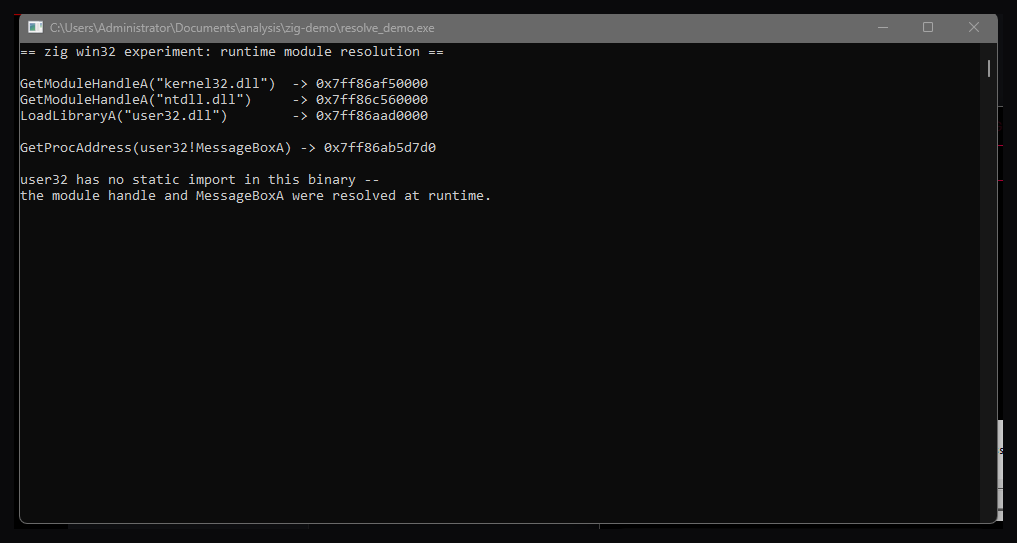
- Dynamic loading — manual
LoadLibrary/GetProcAddressusage and observation of the module resolution order - PE/loader behavior — inspecting how the loader maps images, resolves imports, and handles relocations
- GDI rendering — drawing directly against the GDI API to understand the graphics/device-context model
- Zig↔Win32 interop — extern declarations, calling conventions, and wide-string handling at the ABI boundary
security considerations / methodology
All experiments are platform-behavior probes — they observe documented API behavior rather than exploit anything. The same knowledge applies in both directions: writing tooling, and recognizing what anomalous loading or rendering behavior looks like.
interesting problems encountered
- Zig↔C interop friction: wide strings, calling conventions, and getting extern declarations exactly right
- Cases where observed loader behavior differed from what the documentation implies — resolved by tracing with a debugger instead of reading docs
what i built
- A set of working experiment binaries, each isolating one platform mechanism
- Notes connecting observed behavior to the security research work — how loading and resolution actually work is prerequisite knowledge for both offense and detection
results
Working, minimal demonstrations of each mechanism studied.
evidence
what i learned / next steps
Comfort operating at the Win32 API layer without framework support. Next: expanding into additional loader and process-internals areas that feed the security research.