Windows Security Research
what it is
An ongoing private research project into how Windows actually enforces privilege boundaries — specifically UAC, COM interfaces, and auto-elevation behavior — and what that activity looks like to a defender.
problem / objective
Windows privilege separation has documented seams — auto-elevated binaries, COM interfaces callable across the boundary, and behavior that differs between documentation and implementation. The objective is to map where the boundary actually holds, where it has documented gaps, and which artifacts each behavior leaves behind for detection.
environment
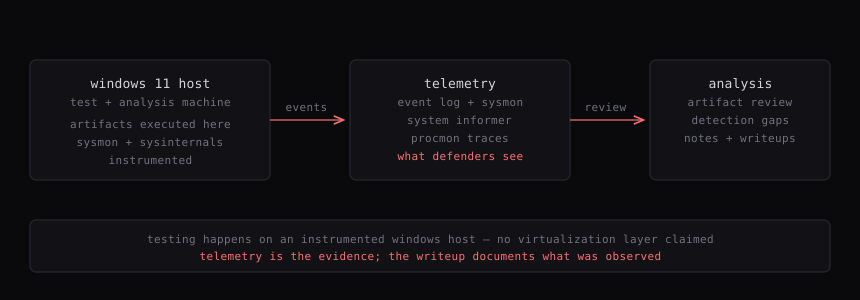
- Instrumented Windows 11 host used as the test environment — no virtualization layer
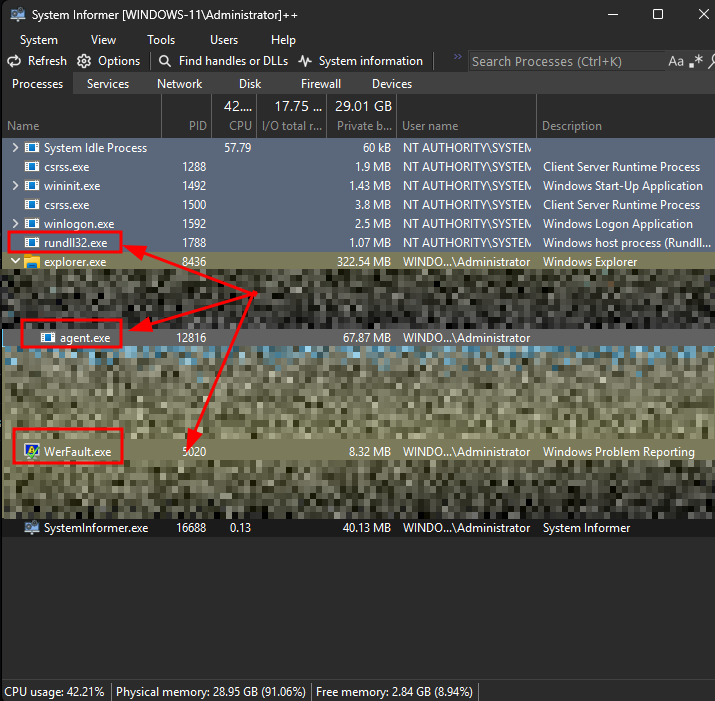
- Sysinternals suite (System Informer, Procmon, Autoruns) plus Windows eventing/Sysmon for telemetry on-target
- Persistent-state analysis — the host accumulates real artifacts across runs, which is part of what makes the telemetry interesting
architecture / design
The environment is deliberately simple: an instrumented Windows host where artifacts execute while Sysinternals and Windows eventing capture the resulting telemetry. Captures are compared across runs to separate normal platform noise from test-induced artifacts.
technical implementation
- Enumeration of auto-elevated binaries and COM interfaces exposed across the UAC boundary
- Reproduction of documented boundary behaviors under controlled conditions
- Artifact capture per test: event logs, process creation telemetry, registry and filesystem traces
- Correlation of observed artifacts against expected detection surface
security considerations / methodology
- Testing is limited to documented, publicly described techniques — the work is understanding and validating boundaries, not developing novel exploits
- All testing happens inside the isolated lab; nothing touches production systems or third parties
- Baseline validation with benign artifacts (EICAR-class test files) before any technique testing — if the sensor can't see a test file, it won't see anything else
interesting problems encountered
- Separating technique-specific artifacts from baseline system noise in event telemetry
- Determining which boundary behaviors are version-dependent versus consistent across builds
what i built
- Repeatable test procedures for each boundary behavior under study
- A structured research log mapping techniques to their observable artifacts
- Detection notes per technique — what a defender can see and where the gaps are
results
Documented boundary behaviors with their artifact and detection surface.
evidence
what i learned / next steps
Deeper familiarity with Windows internals than documentation alone provides — and a practical sense of what defenders can and cannot observe. Next: expanding coverage to additional boundary mechanisms and formalizing the detection notes into something publishable.